MINERVA-35 is a prescription hormonal medicine used in women of reproductive age to treat certain skin and hair concerns that are linked to androgens (male-type hormones). In addition to improving acne, very oily skin (seborrhoea), and excessive hair growth (hirsutism)—including when these occur with polycystic ovary syndrome (PCOS)—MINERVA-35 also works as a combined oral contraceptive (“the Pill”). Because of its contraceptive action, your doctor will only prescribe it if they believe a hormonal contraceptive is also suitable for you.
Quick facts
- Active ingredients: ethinylestradiol 0,035 mg + cyproterone acetate 2 mg per beige tablet
- Scheduling: S4 (prescription only in South Africa)
- Main uses: acne, very oily skin, and excessive hair growth in women of reproductive age; also prevents pregnancy
- Pack: 28 tablets (21 beige hormone-containing tablets + 7 white hormone-free tablets)
- Contains sugars: lactose and sucrose
- Not for: pregnancy, breastfeeding, men, or use alongside another hormonal contraceptive
- No STI protection: does not protect against HIV/AIDS or other sexually transmitted infections (use condoms to reduce STI risk)
What it is and what it is used for
Active ingredients and class
- Ethinylestradiol (0,035 mg): a synthetic oestrogen.
- Cyproterone acetate (2 mg): a progestogen with anti-androgen activity (it helps counter the effects of androgens).
Indications/uses (as per source)
MINERVA-35 is used to treat acne, very oily skin, and excessive hair growth in women of reproductive age, including those with PCOS who need treatment for these symptoms. It also functions as a hormonal contraceptive and should only be prescribed if your doctor considers a combined oral contraceptive appropriate. You should only take MINERVA-35 if your doctor decides that other anti-acne options (such as topical treatments or antibiotics) are not suitable for you.
How it works (simple explanation)
MINERVA-35 combines an oestrogen (ethinylestradiol) and a progestogen with anti-androgen effects (cyproterone acetate). Together they:
- Regulate hormone levels that can drive acne, oiliness, and unwanted hair growth.
- Reduce androgen influence on the skin’s oil glands and hair follicles, which helps clear acne, decrease oil production, and slow excessive hair growth.
- Prevent ovulation and thicken cervical mucus, providing contraception when taken correctly.
Who should NOT use this medicine
Do not take MINERVA-35 if any of the following apply:
- You are allergic to ethinylestradiol, cyproterone acetate, or any tablet ingredient (e.g., rash, itching, swelling after use).
- You currently have or ever had a blood clot (e.g., deep vein thrombosis in the leg, pulmonary embolism in the lung) or any other serious clot anywhere in the body.
- You currently have or ever had a heart attack or stroke, or a condition that can warn of these (such as angina or a transient ischaemic attack).
- You have (or have ever had) a migraine with visual changes, speech difficulties, or weakness/numbness.
- You have conditions that increase the risk of arterial clots, including:
- Diabetes with blood-vessel involvement
- Very high blood pressure
- Very high cholesterol or triglycerides
- You have a blood-clotting disorder (e.g., protein C deficiency).
- You have (or have ever had) liver disease and your liver is not yet normal (symptoms can include widespread itching or yellowing of the skin).
- You are taking certain hepatitis C antiviral combinations containing ombitasvir, paritaprevir, dasabuvir (alone or in combination).
- You have (or have ever had) a hormone-sensitive cancer (e.g., of the breast or genital organs).
- You have (or have ever had) liver tumours (benign or malignant).
- You have unexplained vaginal bleeding.
- You are using another hormonal contraceptive.
- You are pregnant, think you may be pregnant, or are breastfeeding.
Stop using MINERVA-35 and contact your doctor immediately if any of the above appear for the first time during use.
Warnings and precautions (Read before use)
Certain situations require extra care and possibly regular check-ups while using MINERVA-35. Tell your doctor if any of the following apply before you start, or if they develop or worsen during treatment:
- Smoking, especially age >35 years
- Diabetes
- Overweight
- High blood pressure
- Heart valve disease or certain heart rhythm disorders
- Inflamed veins (superficial phlebitis) or varicose veins
- Personal or close family history of blood clots, heart attack, or stroke at a young age
- Migraine (with or without aura)
- Epilepsy
- Personal or family history of high cholesterol/triglycerides
- Breast cancer in a close relative
- Liver or gallbladder disease
- Crohn’s disease or ulcerative colitis
- PCOS
- Systemic lupus erythematosus (SLE)
- Haemolytic uraemic syndrome (HUS)
- Sickle cell disease
- Conditions that first occurred or worsened during pregnancy or previous sex-hormone use (e.g., hearing loss, porphyria, herpes gestationis, Sydenham’s chorea)
- Chloasma (“pregnancy patches”): avoid sun and UV exposure
- Hereditary angioedema: oestrogens may trigger or worsen swelling (seek urgent help if swelling of face/tongue/throat, trouble swallowing or breathing, or hives occur)
Depression and mood changes
Some users of hormonal contraceptives, including MINERVA-35, have reported depression or low mood, which can be serious and may lead to suicidal thoughts. Seek medical advice promptly if you experience mood changes or depressive symptoms.
MINERVA-35 and blood clots
Combined pills slightly increase the risk of blood clots (thrombosis) compared with not using them. The risk is highest in the first year of use and is still lower than during pregnancy. Clots may form in veins (e.g., leg, lungs) or arteries (heart, brain).
Risk factors that further increase clot risk include:
- Getting older
- Smoking (especially if you are over 35)
- Being overweight
- High blood pressure
- High cholesterol/triglycerides
- Migraine
- Heart problems (valve defects, rhythm disorders)
- Family history of early heart attack/stroke or clots
- Immobilisation, surgery, long bedrest, or a leg cast (you may need to stop MINERVA-35 several weeks before planned surgery—your doctor will advise when to restart)
Symptoms of a possible blood clot—seek urgent medical help and stop taking the tablets if you develop:
- Sudden cough for no clear reason; severe chest pain (may spread to left arm); shortness of breath; rapid or irregular heartbeat
- Severe or unusual headache, worsening migraine; fainting or dizziness
- Vision loss (partial or complete) or double vision
- Slurred speech or trouble speaking; sudden change in hearing, smell, or taste
- Weakness or numbness in any part of the body
- Severe abdominal pain
- Severe pain or swelling in one leg
Cancer information
- Breast cancer has been observed slightly more often in users of combined pills; whether this is caused by the pill or due to more frequent medical checks is not certain. The excess risk gradually reduces after stopping. Check your breasts regularly and see your doctor if you feel a lump.
- Rare liver tumours (benign or malignant) have been reported in pill users and may cause severe abdominal pain due to internal bleeding—seek medical help if this occurs.
- Long-term pill use may be associated with a higher risk of cervical cancer; persistent HPV infection is the main risk factor.
Bleeding changes
- Irregular spotting or breakthrough bleeding can occur in the first three cycles. Continue tablets as usual. If bleeding continues, becomes heavy, or restarts, contact your doctor.
- If you took all tablets correctly and did not vomit or have severe diarrhoea, absence of the expected bleed during the white-tablet days makes pregnancy unlikely. If the expected bleed fails to occur twice in a row or if you missed tablets, speak to your doctor before starting a new pack and use non-hormonal contraception in the meantime.
Important: MINERVA-35 does not protect against HIV or any sexually transmitted infections—use condoms to reduce STI risk.
Pregnancy, planning pregnancy, and breastfeeding
- Do not take MINERVA-35 if you are pregnant or think you may be pregnant. If you become pregnant while taking it, stop immediately and contact your doctor.
- If you plan a pregnancy, you can stop at any time. Waiting for one natural period before trying can make it easier to date the pregnancy.
- Breastfeeding: Do not use MINERVA-35 while breastfeeding.
Interactions
Always tell your doctor, pharmacist, or nurse about all medicines, complementary or traditional products, and herbal remedies you use. Some reduce effectiveness or cause unexpected bleeding; others may have their effect changed by MINERVA-35.
Can reduce MINERVA-35’s effectiveness or alter hormone levels (may cause breakthrough bleeding):
- Epilepsy medicines: primidone, phenytoin, barbiturates, carbamazepine, oxcarbazepine, topiramate, felbamate
- Tuberculosis: rifampicin
- HIV or HCV treatments: certain protease inhibitors and non-nucleoside reverse transcriptase inhibitors
- Antifungals: griseofulvin; azoles such as itraconazole, voriconazole, fluconazole
- Antibiotics (macrolides): clarithromycin, erythromycin
- Cardiovascular (calcium channel blockers): verapamil, diltiazem
- Analgesic/anti-inflammatory: etoricoxib
- Herbal remedy: St John’s wort
- Food/juice: grapefruit juice
MINERVA-35 may affect other medicines, including:
- Lamotrigine, cyclosporine, melatonin, midazolam, theophylline, tizanidine
Laboratory tests: Oral contraceptives can affect blood test results; inform your healthcare provider and the laboratory that you are using MINERVA-35.
How to take (Step-by-step)
Key principle: MINERVA-35 must be taken regularly to maintain both therapeutic effects and contraceptive protection. Irregular use may cause inter-menstrual bleeding and reduce effectiveness.
Your pack
- 28 tablets total:
- 21 beige tablets (contain hormones: ethinylestradiol 0,035 mg + cyproterone acetate 2 mg)
- 7 larger white tablets (hormone-free)
Daily dosing
- Take one tablet every day at about the same time, with a little water if needed.
- Follow the arrows on the blister through all 28 tablets.
- Your withdrawal bleed usually starts while taking tablets from the silver section (during the white tablets), often 2–3 days after the last beige tablet.
- Do not leave a gap between packs: start the next pack the very next day after finishing the current one, even if your bleeding continues. This keeps your cycle predictable and maintains contraceptive protection.
When to start your first pack
If you haven’t used hormonal contraception in the previous month
- Wait for your next period. Start on Day 1 of bleeding from the silver section and select the correct day of the week (e.g., “MO” for Monday).
- Use extra contraception (e.g., condoms) for the first 14 days of your first cycle.
Switching from another combined pill, ring, or patch
- Start the day after the last hormone-containing tablet of your previous pack (i.e., no tablet-free break).
- If your pack has placebo tablets, start MINERVA-35 after the last active tablet (ask if unsure).
- If switching from a vaginal ring or patch, start on the day of removal of the final ring or patch of the cycle.
- When these instructions are followed, no additional contraception is needed.
Switching from a progestogen-only method (POP, injection, implant, or IUS)
- You may switch any day from the POP; on the day of removal for an implant or IUS; or when the next injection would be due.
- Use extra contraception for the first 14 days after starting MINERVA-35.
After a miscarriage
- Follow your doctor’s advice and use extra protection for the first 14 days of the first cycle.
After having a baby
- Your doctor may recommend waiting until after your first normal period to start, though some may advise earlier.
- Use extra protection for the first 14 days of the first cycle.
- If you had sex after delivery and before starting, ensure you’re not pregnant or wait for your next period.
- If you are breastfeeding, discuss with your doctor before starting (MINERVA-35 is not to be used during breastfeeding).
Missed dose and gastrointestinal upset
Missed white (hormone-free) tablets
- No contraceptive effect relies on these. Take your next tablet at the usual time and discard the missed white tablet(s) to avoid confusion.
- If the last tablet in the pack is missed, it is still essential to start the next pack on time.
Missed beige (hormone-containing) tablets
- Less than 12 hours late: Take the tablet as soon as you remember and continue the next one at the usual time. Protection remains intact.
- More than 12 hours late: Protection may be reduced. The more beige tablets missed, the higher the risk—especially if missed right after the white-tablet days (start of the cycle) or towards the end (last of the 21 beige tablets).
- Use condoms for the next 7 days.
- Do not take more than two beige tablets in one day to catch up.
- If you missed beige tablets and no withdrawal bleed occurs during the white-tablet days, you may be pregnant—contact your doctor before starting a new pack.
Vomiting or severe diarrhoea
- If vomiting occurs within 3–4 hours after a beige tablet, treat it as a missed beige tablet and follow the missed-pill guidance above.
- Severe diarrhoea may reduce absorption—contact your doctor.
- Vomiting/diarrhoea during the white tablets does not affect protection.
Overdose
Taking several hormone-containing tablets at once may cause nausea, vomiting, or vaginal bleeding (even in girls who haven’t started menstruating). Seek advice from your doctor or pharmacist if too many tablets have been taken or a child has taken them.
How long to use
Treatment typically lasts several months. Acne and oiliness usually improve sooner than hirsutism. It is recommended to continue for 3–4 cycles after symptoms have settled. If symptoms recur weeks or months after stopping, treatment may be resumed. If restarting after a ≥4-week break, note the increased venous thromboembolism (VTE) risk as per the blood-clot warnings.
Dosing table (from source guidance)
Important: Follow the arrows on your blister and take one tablet daily at the same time.
| Situation | What to do | Extra contraception |
|---|---|---|
| Standard use | 1 tablet daily: 21 beige (active) followed by 7 white (hormone-free). Start next pack without a gap. | Not required if taken correctly |
| First start (no hormones in past month) | Start Day 1 of your period from the silver section and correct weekday. | Yes – for first 14 days |
| Switching from combined pill/ring/patch | Start day after last active tablet (no break), or day of ring/patch removal. | Not required if instructions followed |
| Switching from POP/implant/IUS/injection | Start any day (POP), on removal day (implant/IUS), or when next injection due. | Yes – for first 14 days |
| Missed white tablets | Skip missed white tablet(s); continue as normal. | Not required |
| Beige tablet <12 h late | Take as soon as remembered; continue at usual time. | Not required |
| Beige tablet >12 h late | Take latest missed tablet; continue; do not >2 beige/day. | Yes – for next 7 days |
| Vomiting within 3–4 h of beige tablet | Treat as missed beige tablet. | As per missed-pill rule |
| Severe diarrhoea | Contact doctor. | As advised |
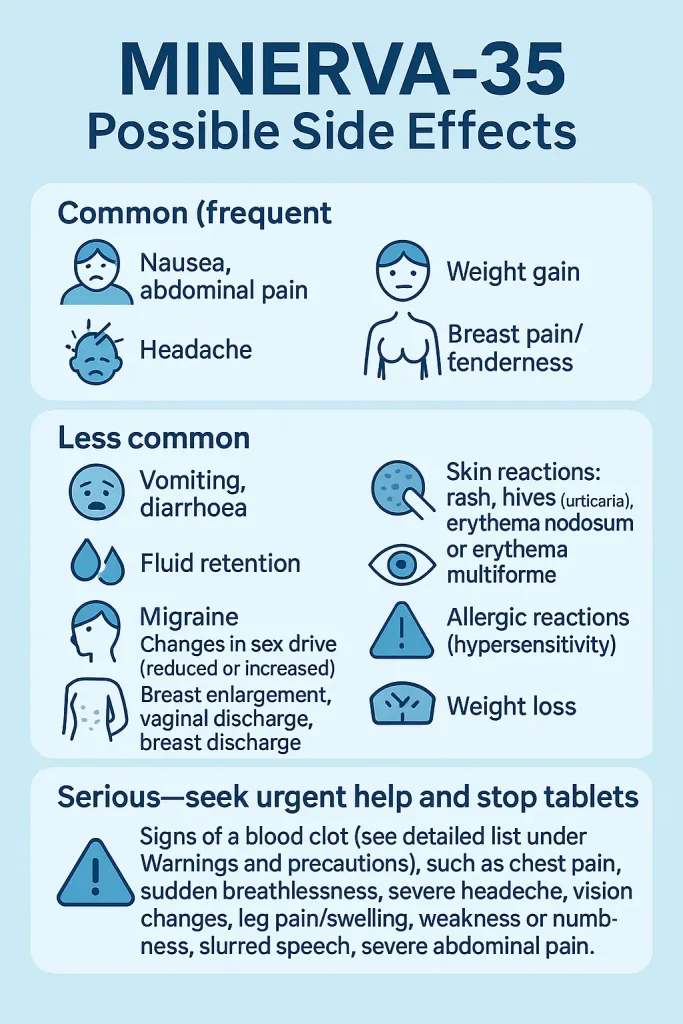
Possible side effects
Not everyone gets side effects. If your general health worsens or you notice any troubling effect, seek medical advice.
Common (frequent)
- Nausea, abdominal pain
- Headache
- Weight gain
- Breast pain/tenderness
- Depressed mood or mood changes
Less common
- Vomiting, diarrhoea
- Fluid retention
- Migraine
- Changes in sex drive (reduced or increased)
- Breast enlargement, vaginal discharge, breast discharge
- Skin reactions: rash, hives (urticaria), erythema nodosum or erythema multiforme
- Contact lens intolerance
- Allergic reactions (hypersensitivity)
- Weight loss
- Venous blood clot
Serious—seek urgent help and stop tablets
- Signs of a blood clot (see detailed list under Warnings and precautions), such as chest pain, sudden breathlessness, severe headache, vision changes, leg pain/swelling, weakness or numbness, slurred speech, severe abdominal pain.
Reporting side effects
Speak to your doctor or pharmacist if you get side effects.
Storage and disposal
- Keep out of sight and reach of children.
- Store at or below 30 °C.
- Return unused medicine to your pharmacist. Do not dispose of in drains or toilets.
What the medicine contains
Active (per beige tablet):
- Ethinylestradiol 0,035 mg
- Cyproterone acetate 2 mg
Other ingredients (excipients):
Calcium carbonate (precipitated), ferric oxide pigment yellow, lactose monohydrate, macrogol 6000, magnesium stearate, maize starch, montanglycol wax, povidone 25, povidone 700 000, sucrose, talc, glycerol 85 %, titanium dioxide.
Note: Contains lactose and sucrose. If you have been told you have sugar intolerances, speak to your doctor before use.
Pack information and appearance
- Blister pack containing 21 beige hormone-containing coated tablets and 7 larger white hormone-free coated tablets (total 28 tablets).
- Blister materials: transparent PVC film and aluminium foil.
Practical FAQs (based ONLY on the source)
Does MINERVA-35 protect against HIV or STIs?
No. It does not protect against HIV/AIDS or other sexually transmitted infections. Use condoms to reduce the risk of STIs.
Can I use MINERVA-35 if I am pregnant or breastfeeding?
No. Do not use if you are pregnant or think you may be pregnant. Do not use while breastfeeding.
I forgot a white (hormone-free) tablet—what now?
Simply continue with the next tablet at the usual time and discard the missed white tablet(s). Start your next pack on time.
I forgot a beige (hormone) tablet. What should I do?
If <12 hours late, take it as soon as remembered; protection is maintained. If >12 hours late, take the most recently missed tablet, continue as normal (never more than two beige tablets in one day), and use extra contraception for 7 days.
What if I vomit after taking a beige tablet?
If you vomit within 3–4 hours, treat it as a missed beige tablet and follow the missed-pill guidance.
When should I start after giving birth or a miscarriage?
After a miscarriage: follow your doctor’s advice and use extra protection for the first 14 days of the first cycle.
After having a baby: your doctor may advise starting after your first normal period (sometimes earlier). Use extra protection for the first 14 days; do not use if breastfeeding unless advised otherwise by your doctor.
Can I smoke while taking MINERVA-35?
If you use a hormonal contraceptive such as MINERVA-35, you are strongly advised to stop smoking, especially if you are over 35 years of age, because smoking increases the risk of blood clots, heart attack, and stroke.
Will it affect my blood tests?
Yes, oral contraceptives can affect some laboratory results. Tell your doctor or the lab that you are taking MINERVA-35.
Can I drive or use machines while taking MINERVA-35?
No studies have been performed on the effects of MINERVA-35 on driving or machine use.
How long should I keep taking it for acne or hirsutism?
Treatment usually lasts several months. Continue for 3–4 cycles after symptoms improve. If symptoms return weeks or months after stopping, talk to your doctor about restarting.

Education:
NPU (National Pharmaceutical University) 2010-2015, 2015-2016 internship
Work experience:
2010 – 2012 Pharmacy 63 – Production Department
2012 – 2015 Pharmacy 63 – Pharmacist
2015 – 2016 Pharmacy 63 – Pharmacist
2016 – to date Pharmacy UA – Head of Pharmacy