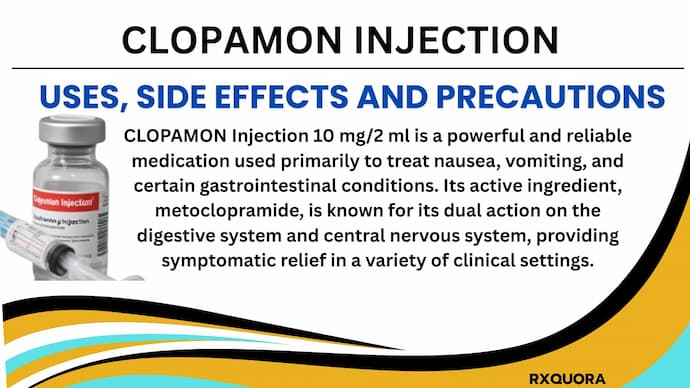
CLOPAMON Injection 10 mg/2 ml is a powerful and reliable medication used primarily to treat nausea, vomiting, and certain gastrointestinal conditions. Its active ingredient, metoclopramide, is known for its dual action on the digestive system and central nervous system, providing symptomatic relief in a variety of clinical settings.
1. Scheduling Status
CLOPAMON Injection falls under Schedule 4 (S4), which means it is a prescription-only medicine. It should be used under the supervision of a qualified healthcare provider.
2. Proprietary Name and Dosage Form
- Brand Name: CLOPAMON INJECTION
- Strength: 10 mg of metoclopramide per 2 ml
- Form: Clear, colorless injectable liquid
This medication is supplied in ampoules for intramuscular (IM) or intravenous (IV) use.
3. Composition
Each 2 ml ampoule of CLOPAMON Injection contains:
| Component | Quantity |
|---|---|
| Metoclopramide | 10 mg |
| Sodium chloride | As excipient |
| Water for injection | As excipient |
| Sugar | Free |
The formulation is isotonic and stable when administered as intended. It must not be diluted before injection.
4. Category and Class
CLOPAMON belongs to:
- Category: A 5.7.2
- Pharmacological Class: Anti-emetics and antivertigo preparations
It is primarily used to control nausea, vomiting, and gastrointestinal motility issues.
5. CLOPAMON Injection Uses
CLOPAMON Injection works through multiple mechanisms, offering both gastrointestinal and anti-emetic benefits.
Pharmacodynamic Properties
Gastrointestinal Action
Metoclopramide stimulates the digestive tract by:
- Increasing the frequency and strength of antral (stomach) contractions
- Enhancing duodenal motility
- Accelerating gastric emptying
This action makes CLOPAMON useful in treating conditions involving delayed stomach emptying and gastrointestinal stasis.
Gastro-Oesophageal Junction
It increases pressure at the cardiac sphincter, helping to prevent acid reflux and regurgitation. This effect is more pronounced in individuals with normal resting sphincter pressure.
Effect of Anticholinergics
Anticholinergic medications like atropine can diminish the gastrointestinal effects of CLOPAMON if taken within three hours of administration.
Anti-Emetic Action
CLOPAMON works centrally by acting on the chemoreceptor trigger zone (CTZ) in the brain to suppress nausea and vomiting. This action remains effective even in the presence of anticholinergic medications.
Other Actions
Metoclopramide also stimulates prolactin secretion, which may lead to hormonal side effects in some users.
6. Indications
CLOPAMON Injection is used in the following clinical situations:
Digestive Disorders
- Post-vagotomy syndrome
- Conditions associated with delayed gastric emptying or hypomotility
Nausea and Vomiting
Effective in controlling nausea and vomiting caused by:
- Medications
- Kidney failure (uraemia)
- Cancer
- Gastrointestinal disorders
- Post-anaesthetic recovery
Diagnostic Radiology
Improves visualization during imaging studies by:
| Use Case | Purpose |
|---|---|
| Delayed barium meal studies | Reduces spasm in the duodenal cap |
| Hypotonic stomach (gastric stasis) | Enhances emptying and visual clarity |
| Preventing vomiting during barium exams | Reduces risk of emesis in sensitive patients |
Duodenal Intubation
Facilitates gastrointestinal procedures by:
- Promoting gastric emptying
- Reducing nausea and gag reflexes
7. Contraindications
CLOPAMON should not be used in the following conditions:
- Gastrointestinal bleeding, obstruction, or perforation
- Immediately post-operative GI surgery
- Phaeochromocytoma (risk of hypertensive crisis)
- Epilepsy (risk of seizures)
- Porphyria
Use is also discouraged in scenarios where increased gastrointestinal motility could be dangerous.
8. Warnings and Special Precautions
- Pregnancy: Safety is not established. Use only if absolutely necessary.
- Children and Elderly: Higher risk of extrapyramidal symptoms. Caution is advised.
- Renal or Hepatic Impairment: Risk of fluid retention and toxicity; monitor closely.
- Dilution Warning: Do not dilute ampoules as it affects isotonicity and drug stability.
- Long-Term Use: Requires regular medical review.
9. Interactions
CLOPAMON can interact with several medications:
| Interacting Substance | Effect |
|---|---|
| Phenothiazines | Increased risk of extrapyramidal reactions |
| Lithium | Increased toxicity |
| Antidepressants & antiepileptics | Caution due to central nervous system effects |
| Antimuscarinics & opioids | Reduce CLOPAMON’s GI effects |
| Digoxin | Reduced stomach absorption |
| Aspirin, Paracetamol | Increased small intestine absorption |
| Suxamethonium | Prolonged neuromuscular blockade |
| Bromocriptine | Reduced effectiveness due to raised prolactin levels |
10. Human Reproduction
- Pregnancy: Not established as safe.
- Use during pregnancy only when clearly needed and under professional guidance.
11. Dosage and Directions for Use
Parenteral Administration
| Age Group | Dosage | Route |
|---|---|---|
| Adults & Children >14 yrs | 10 mg (1 ampoule), 1–3 times daily | IV or IM |
| Children 5–14 yrs | 2.5 mg (0.5 ml of ampoule), twice daily | IV or IM |
| Children 3–5 yrs | 1 mg (0.2 ml), twice daily | IV or IM |
| Children 1–3 yrs | 0.5 mg (0.1 ml), twice daily | IV or IM |
Children’s doses should be given using a tuberculin syringe for accuracy.
For Diagnostic Radiology
| Route | Dose | Timing Before Procedure |
|---|---|---|
| IV | 10–20 mg (1–2 ampoules) | 5–15 minutes before barium meal |
| IM | 10–20 mg | 10–15 minutes before barium meal |
12. Side Effects
CLOPAMON may cause various side effects, especially during prolonged use or in vulnerable populations.
Common Reactions
- Extrapyramidal symptoms (more common in young females)
- Restlessness, dizziness, drowsiness, and headaches
- Gastrointestinal upsets like diarrhea
Rare and Serious Reactions
| Condition | Description |
|---|---|
| Parkinsonism, tardive dyskinesia | Usually in elderly or prolonged use |
| Hypotension/Hypertension | Blood pressure changes |
| Depression | Mood-related side effects |
| Blood disorders | Rare blood count abnormalities |
| Hypersensitivity reactions | Allergic responses |
| Neuroleptic malignant syndrome | Life-threatening, rare reaction |
| Urinary incontinence | Uncontrolled urination |
| Hormonal effects (galactorrhoea) | Due to prolactin stimulation |
| Raised aldosterone levels | Temporary hormonal imbalance |
13. Known Symptoms of Overdosage and Treatment
Symptoms of Overdose
Overdose may lead to:
- Dyskinetic reactions
- Muscle spasms (especially of the face and neck)
- Tongue protrusion
- In severe cases: opisthotonos (severe body arching)
Treatment
Treatment involves administering anti-Parkinson drugs such as procyclidine to counteract movement disorders.
14. Identification
- Appearance: Clear, colorless liquid
15. Presentation
CLOPAMON Injection is packaged as follows:
- 1 x 2 ml ampoule per unit
- 10 ampoules per pack, supplied in a polystyrene container
- Includes patient information leaflet
16. Storage Instructions
| Storage Parameter | Requirement |
|---|---|
| Temperature | Store at or below 25 °C |
| Light | Protect from light |
| Packaging | Keep in original packaging |
| Discoloration | Discard ampoules that appear yellow |
| Safety | Keep out of reach of children |
17. Name and Business Address of the Holder of the Certificate of Registration
Pharmacare Limited
Healthcare Park, Woodlands Drive
Woodmead 2191, South Africa
Final Thoughts
CLOPAMON Injection 10 mg/2 ml is a versatile, clinically trusted medication with multiple uses across gastroenterology, radiology, and post-operative care. However, due to the potential for serious side effects, it should only be used under appropriate medical supervision. Patients and healthcare providers must be vigilant about dosage, contraindications, and possible interactions to ensure safe and effective treatment.
If you’re considering this medication or have been prescribed CLOPAMON, consult your healthcare provider for detailed guidance tailored to your medical history.
Sources: SAHPRA

Education:
Maria Shkarletova Kupyanskiy Medical College 2008-2012
NPU (National Pharmaceutical University) 2013-2018
Work experience:
2012 – 2014 Center for Emergency Medical Care and Catastrophe Medicine. Regional Perinatal Center – Midwife
2014 – 2015 Titan TPO Health Pharmacy – Pharmacist
2015 – 2016 FOP Kravchenko – Pharmacist
2016 – 2018 FOP Kravchenko Pharmacy – Pharmacist
2018 – to date FOP Sanders Loft (Wholesale Pharmacy) – Pharmacist